Image credit: Sam Benson.
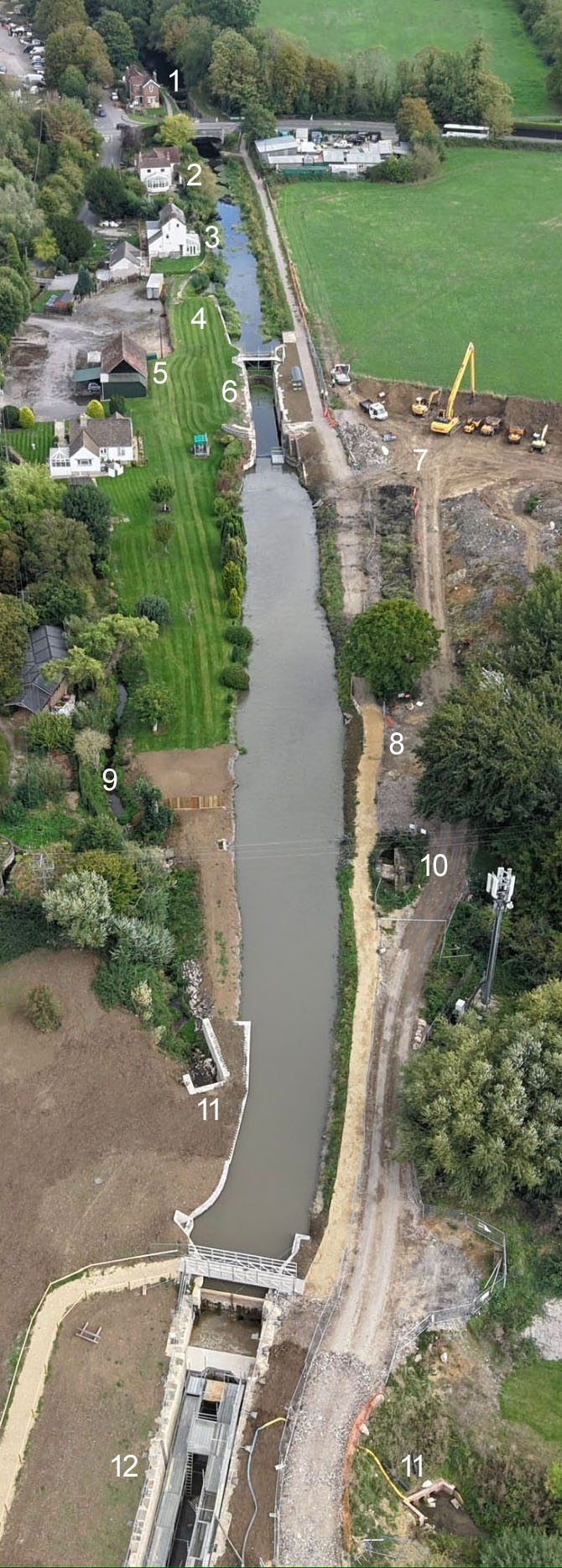
The recently restored lower half of the Eastington flight of locks passes several historic sites.
At the top, red brick Pike Lock House (1) housed the canal company employee who looked after all five locks in the flight. The original Pike Bridge (adjoining) carried a turnpike road over the canal, and the foundations of this narrow bridge are visible from the towpath under the modern structure. More.
The white house (2) near the bridge marks the site of the wharf, where coal was landed for the nearby village of Eastington. More.
The lower white house (3) housed the canal company's surveyor, who oversaw the neighbouring maintenance yard, including a dry dock (4 now filled in), a carpenter's shop (demolished), and a timber storage shed (5 still in situ). More.
Dock Lock (6) was named after the nearby dry dock. The white house adjoining the lock is modern. More.
To the right of Dock Lock is a yard (7) for storing excavated topsoil, subsoil, clay, and gravel for later use in the restoration project.
The canal below Dock Lock is particularly wide because the former towpath subsided into the canal and was cleared away. The modern track is on higher ground that was formerly part of the neighbouring field.
Below the big tree was once an enclosed pen (8) for storing coal on its way to Meadow Mill on the River Frome. More.
The Oldbury Brook (9) formerly flowed into the canal opposite to a spill weir (10) that carried away surplus water. The spill weir structure survives, but the brook now passes diagonally under the canal, with white walls (11) marking the culvert's entry and exit. More.
Westfield Lock (12) was filled in c. 1970 as part of the M5 motorway works. Volunteers restored the lock, now known as John Robinson Lock in memory of a generous benefactor. More.